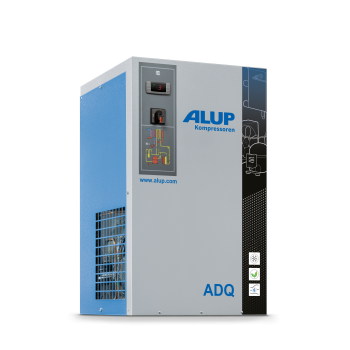
Alup ADQ series refrigeration dryers meet the highest standards, with capacities starting from 350L/min
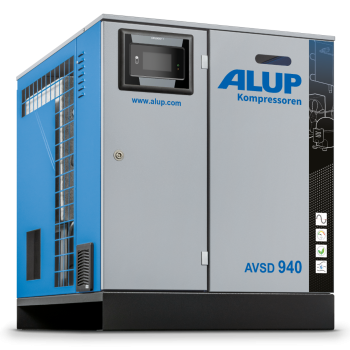
Alup AVSD series refrigeration dryers feature a frequency inverter and are designed for higher-capacity screw compressors to ensure maximum energy savings.
What is a refrigeration dryer?
+
What is a refrigeration dryer?
A refrigeration dryer is an industrial device used in compressed air systems to remove moisture and water vapor. When air is compressed, its temperature rises and pressure increases, causing the moisture in the air to condense. If this resulting water is not removed from the system in a timely manner, it can cause piping corrosion, damage pneumatic tools, and compromise the quality of the final product.
How does a refrigeration dryer work?
The operating principle of the device is relatively simple and resembles that of a standard household refrigerator or air conditioner. The refrigeration dryer cools the incoming hot compressed air to a temperature of approximately +3 °C to +5 °C, as cold air cannot hold as much moisture as warm air, causing the water vapor to condense into droplets. Afterward, the resulting water is separated using a special separator and discharged from the system via an automatic drain. Before leaving the device, the dried air is reheated by the incoming hot air to prevent condensation from forming on external pipes and to save energy.
Where are refrigeration dryers used and what are their limitations?
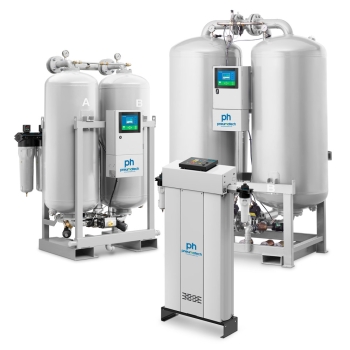
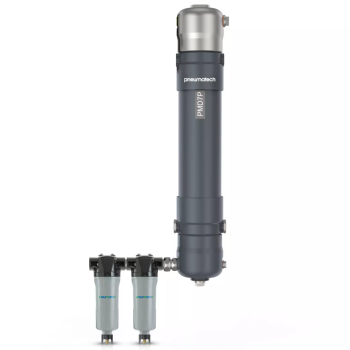
Refrigeration dryers are the most widely used dryers in the industry because they are reliable, low-maintenance, and highly effective for most standard manufacturing processes. Their main limitation is that they cannot lower the air pressure dew point below the freezing point of 0 °C, as otherwise the device would simply freeze up internally. If the production requires extremely dry air—for instance, in the pharmaceutical or food industries where the dew point must be as low as -40 °C—a specialized Adsorption air dryers is used instead of a refrigeration dryer.
How to choose the right compressed air dryer? ALUP ADQ vs AVSD series
+
The efficiency of a compressed air system and the longevity of the equipment directly depend on the degree of air dryness. Alup offers two main series of refrigeration dryers, designed for manufacturing facilities with different workloads. Here are the main differences to help you make the right choice:
The ADQ series (models 21–5400) consists of fixed-speed dryers. They are among the most popular in the world due to their simplicity and durability.
- Operating Principle: The dryer operates at a constant speed, ensuring a stable dew point (+3°C). When air consumption is low, the device uses a hot gas bypass valve to prevent the system from freezing.
- Advantages: Compact design, low noise level, and low pressure drop (below 0.2 bar).
- When to choose: This is the best solution for businesses where compressed air consumption is stable and consistent. The ADQ series requires a lower initial investment and its maintenance is extremely simple.
The AVSD series features a Variable Speed Drive (VSD) dryer, designed to achieve maximum energy efficiency.
- Operating Principle: Unlike standard dryers, the AVSD adjusts its motor speed according to actual air consumption. When demand drops, the dryer's energy consumption drops as well.
- Energy Efficiency: AVSD technology allows for electricity savings of up to 60% compared to conventional refrigeration dryers and reduces CO2 emissions by up to 65%.
- Smart Control: Equipped with the Airlogic2T touchscreen controller, offering real-time monitoring and remote management capabilities (ICONS).
- When to choose: Ideal if your production has shifts with varying loads or if air consumption fluctuates significantly throughout the day. Although the initial investment is higher, it pays off quickly thanks to electricity savings.