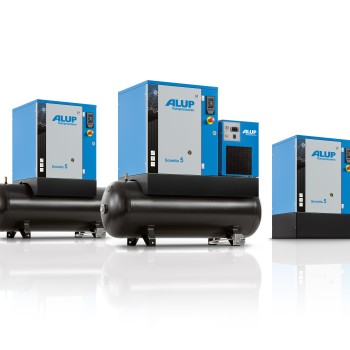
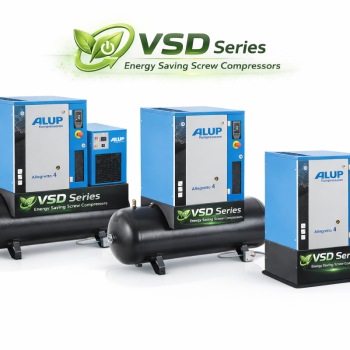
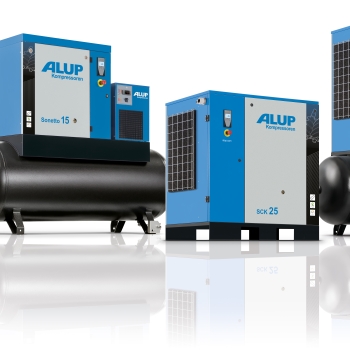
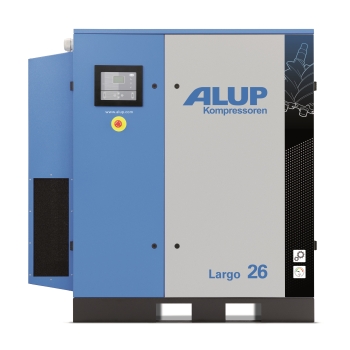
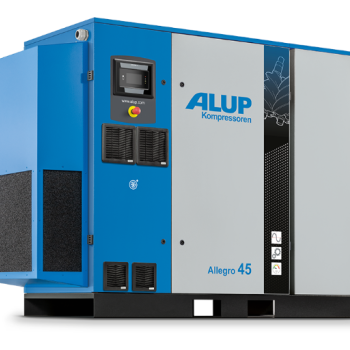
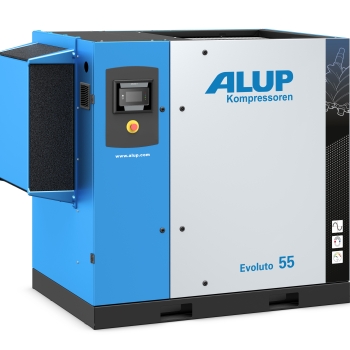
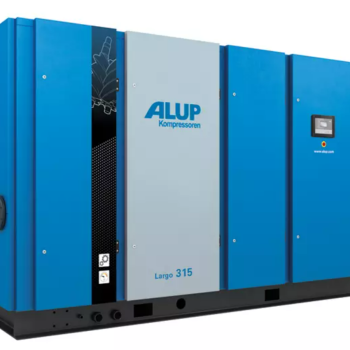
A screw compressor is an industrial device designed for continuous and efficient production of compressed air. Unlike equipment with intermittent duty cycles, screw compressor technology is based on the continuous rotation of rotors. This ensures high productivity, low noise levels, and maximum reliability, allowing the device to operate continuously 24/7 at full load. Thanks to their high energy efficiency and long service life, screw compressors have become the standard choice in modern manufacturing, construction, and industrial enterprises.
Operating principle of a screw compressor
The operation of a screw compressor is based on displacement by reducing volume, which is divided into four main stages: intake, transport, compression, and discharge.
- Intake and transport: At the heart of the device are two precisely machined helical rotors that rotate in opposite directions within a tightly sealed housing. The cavity created by the rotation of the rotors generates a vacuum, which draws ambient air into the device through the inlet valve.
- Compression and discharge: As the rotors continue to move, the inlet opening closes, trapping the air between the rotor lobes. Since the geometry of the lobes progressively narrows toward the discharge outlet, the volume of the air decreases as it moves, mechanically increasing the pressure. At the end of the process, the air that has reached maximum pressure is directed through the discharge outlet into the compressed air system or storage tank.
Screw compressor vs piston compressor: which one to choose?
Choosing the right compressor technology depends directly on air consumption needs, duty cycles, and device requirements. Below are the main differences between an industrial screw compressor and a traditional piston compressor.
- Duty cycle and load capacity: A piston compressor works on the principle of reciprocating pistons, which generates significant friction and heat. Therefore, a piston compressor requires cooling time, and its allowable workload is typically limited to 50–60% of the time. A screw compressor has no such limitation. Its rotary mechanism is designed to operate at 100% load without any risk of overheating.
- Energy efficiency and productivity: Screw compressors have a significantly higher efficiency rate (approximately 95%). Piston compressors suffer from major pressure drops and internal leakage, which increases the cost per cubic meter of produced compressed air. In case of high and continuous air consumption, a screw compressor ensures significant electrical energy savings.
- Noise level and vibration: The operation of piston compressors is accompanied by loud pulsating noise and heavy vibration, which often requires a separate compressor room or a soundproof canopy. Screw compressors run smoothly and quietly, allowing the equipment to be installed directly at the workplace or near the production line.
- Maintenance intervals and wear: Although the initial purchase cost of a piston compressor is lower, its moving parts (valves, rings, cylinders) wear out much faster. The components of a screw compressor do not come into direct contact with each other, which reduces mechanical wear, extends maintenance intervals, and ensures lower operating costs in the long run.
Types of screw compressors: oil-injected and oil-free units
Depending on the cleanliness requirements of the working environment and the quality class of the compressed air, screw compressors are divided into two main types.
Oil-injected screw compressors inject a special compressor oil into the compression chamber. The oil performs three functions: seals the clearances between the rotors to prevent backflow, lubricates the moving parts, and cools the compressed air directly at the point of generation. Before directing the air to the consumption network, the oil is separated in a special separator and recirculated, ensuring clean technical air.
Oil-free screw compressors do not use any lubricants in the working chamber. Rotor wear and sealing are prevented by special high-tech coatings and extremely precise mechanical tolerances. These units are used in sectors with strict hygiene standards, such as the food industry, medical applications, electronics, and pharmaceuticals, where any risk of oil residue in the compressed air must be excluded.